
Winter tyres and snow chains in France: what the Mountain Law says
The rules on winter tyres and snow chains in France apply from 1 November to 31 March in the municipalities designated by the prefects. Tyres, chains, road signs, penalties and hire cars: here is the rule, backed up by the official texts.
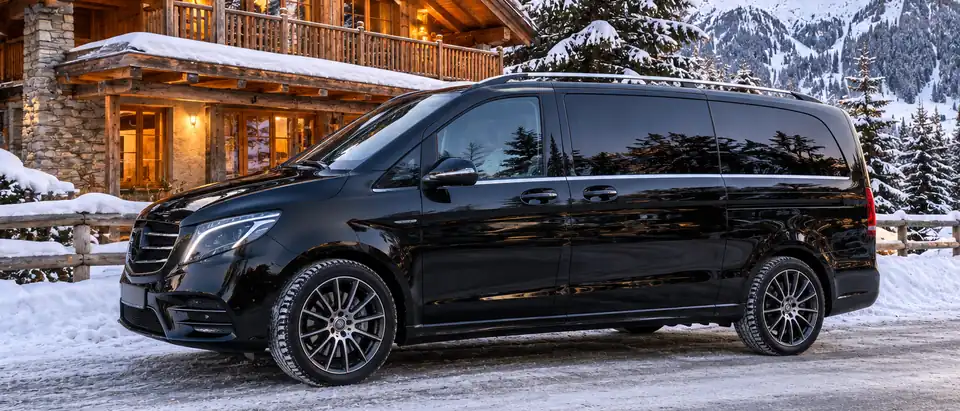
From 1 November to 31 March, in the municipalities designated by the prefects, including the whole of Savoie and Haute-Savoie, a car must have four winter tyres marked 3PMSF, or snow chains or snow socks on board. With tyres marked only M+S, chains are also required. No fine is applied to date.
What does the Mountain Law say about winter equipment?
The rule commonly known as the “Mountain Law” (loi Montagne) is laid down by Decree No. 2020-1264 of 16 October 2020 on the obligation to equip certain vehicles during the winter period. This period “begins on 1 November and ends on 31 March of the following year”. The obligation does not apply everywhere: in each mountain range, the prefect of the département sets by order, after consulting the massif committee, the list of municipalities concerned.
For this winter, service-public.fr states that it applies from 1 November 2026 to 31 March 2027 in areas designated by the prefects of 34 départements, in the Alps, Corsica, the Massif Central, the Jura, the Pyrenees and the Vosges. The list of municipalities is published on the securite-routiere.gouv.fr website. The text has applied since 1 November 2021; its second stage, which concerns tyre markings, came into force on 1 November 2024.
Which equipment is accepted?
For a car or a light commercial vehicle, you can choose between two solutions:
- Winter tyres on at least two wheels of each axle, i.e. all four wheels of a car. They must bear the alpine symbol: “only 3PMSF tyres” count as equivalent to chains, service-public.fr specifies.
- Snow chains or snow socks stowed in the vehicle, to be fitted on at least two drive wheels when the road requires it.
Vehicles fitted with studded tyres are exempt. All vehicles with four or more wheels are concerned: cars, vans, motorhomes, but also coaches, buses and heavy goods vehicles, which have their own rules. Here is how to read your own equipment:
| Equipment | Compliant in the zone? | Good to know |
|---|---|---|
| Four 3PMSF tyres | Yes | The tyre must bear the alpine symbol, not just the M+S marking. |
| Tyres marked only M+S | Yes, with chains or snow socks on board | Without the alpine symbol, they are no longer enough on their own since 1 November 2024. |
| Standard tyres, chains or snow socks on board | Yes | To be fitted on at least two drive wheels when the road requires it. |
| Studded tyres | Exempt | The decree classes them as non-removable anti-skid devices. |
| Standard tyres, without chains or snow socks | No | Vehicle not compliant from 1 November to 31 March. |
How do you know if you are entering a mandatory zone?
By the road signs. The B58 sign marks the entrance to a zone where winter equipment is mandatory, completed by a plate reading “from 01/11 to 31/03”; the B59 sign marks its exit. Service-public.fr points out: “Signage is required for the measure to be enforceable”.
In the Northern Alps, the question is quickly settled. In Savoie, the prefecture states that the entire territory of the département is concerned. In Haute-Savoie, the obligation covers the entire road network, under a prefectoral order of 30 September 2021. All the major resorts in these two départements are therefore within the zone, from Megève and Chamonix in Haute-Savoie to Val d'Isère and Tignes in Savoie.
What does the B26 “snow chains compulsory” sign mean?
The B26 sign indicates that special equipment is compulsory. When winter tyres are not enough, the words “chaînes à neige obligatoires” (snow chains compulsory) appear next to it, in an inset. The Savoie prefecture specifies that this sign “still requires chains to be fitted on snow-covered roads”: a vehicle equipped in line with the Mountain Law is compliant, except when this notice is displayed. You must then fit the chains, even with four winter tyres.
That is why a set of chains in the boot remains useful, even with good tyres. Practise fitting them calmly, before you set off: at the side of a snowy road, at night and in the cold, the exercise becomes much more difficult.
What is the fine for not having winter tyres?
To date, there is none. The 2020 decree provides for no penalty. Questioned in the National Assembly and the Senate, the Ministry of the Interior replied in February 2026 that the measure has been applied “in an educational way, without penalty” from the outset: a penalty requires a decree, which “could not be published in 2025”. In November 2026, we found no publication of this decree in the official sources consulted. The amounts circulating online therefore have no official basis at this date.
The absence of a fine does not remove the risk: without equipment, a snowy climb can stop you dead and block the road for others. As for the B26 sign, it applies as soon as it is displayed.
Hire car: how do you check its equipment?
A hire car equipped for snow cannot be taken for granted. At Geneva Airport, for example, the rental companies' conditions on winter tyres are not published by the airport. Ask the question when booking, then check the tyre markings at the desk and make sure there are chains or snow socks in the boot. For the rest of the journey, from choosing the airport sector to driving times, see our guide Geneva airport to ski resorts.
And with a chauffeur, who takes care of the equipment?
We do. For the Alps, our vehicles are equipped for winter in line with the Mountain Law, and your chauffeur knows the mountain roads. They adapt the departure time to the weather and the state of the road, and keep you informed if it snows. All you need to do is tell us, when booking, the number of passengers, pieces of luggage and ski bags. For example, our Geneva – Megève transfer takes you from the airport to your chalet, on quotation, with a fixed price given before booking and no night or weekend surcharge.
On peak departure days, equipment is not everything: see also our advice on Saturday ski traffic in the Alps.
When heavy snowfall is forecast, we call you the day before to bring your departure time forward: on the road to the resorts, that margin is what keeps you from missing your flight.
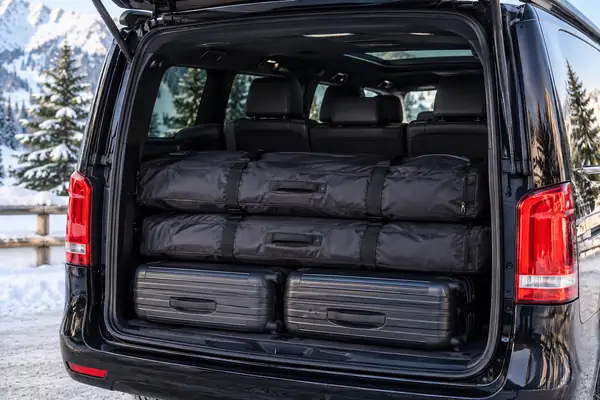
On quotation: you receive a fixed price before you book, with a bilingual chauffeur (French and English) and no night or weekend surcharge.
Frequently asked questions
Are M+S tyres enough?
Not on their own. Tyres marked only M+S, without the alpine symbol, are still allowed, but you must then also carry snow chains or snow socks in the car, according to service-public.fr.
Do you need four winter tyres, or are two enough?
Four, on a car. The decree requires winter tyres on at least two wheels of each axle, which means all four wheels; service-public.fr refers to four winter tyres.
Do snow socks replace chains?
Yes, for the obligation from 1 November to 31 March: chains and snow socks are both accepted removable anti-skid devices, to be fitted on at least two drive wheels.
When does the obligation apply this winter?
From 1 November 2026 to 31 March 2027, in the municipalities designated by the prefects and marked by a B58 sign. In Savoie and Haute-Savoie, the entire road network of the département is concerned.
Where can you find the list of municipalities concerned?
On securite-routiere.gouv.fr, as service-public.fr indicates, and on the websites of the prefectures of the mountain départements.
Are coaches and heavy goods vehicles also concerned?
Yes. Coaches, buses and heavy goods vehicles without a trailer must carry chains for at least two drive wheels, or have winter tyres. Heavy goods vehicles with a trailer must carry chains.
Related articles
- Ski & Alps
A 3 Vallées family ski holiday: planning the journey
From Geneva Airport, allow about 2 hr by road to Moûtiers, then 30 to 60 minutes for the climb.
Checked in November 2026 - Ski & Alps
Arriving at Courchevel altiport by private plane
Courchevel altiport, at 2,007 metres according to the town hall, receives planes and helicopters from 9:00 to 19:00, with no night flights, on a 537-metre sloping runway.
Checked in November 2026 - Ski & Alps
How to get from Paris to Courchevel: train, plane or chauffeur-driven car?
Three routes lead from Paris to Courchevel: the train to Moûtiers, then 30 minutes by road; a flight to Geneva, then just over two hours by road; or the car, about 658 km and 5 hr 52 excluding traffic jams according to Mappy.
Checked in November 2026
Book a private chauffeur online · Geneva to Courchevel private transfer
Sources
- Decree No. 2020-1264 of 16 October 2020 on the obligation to equip certain vehicles during the winter period (Légifrance)
- Winter tyres, chains: what are your obligations until 31 March 2027? (Service-Public.fr, 20 October 2026)
- Compulsory equipment in a car (Service-Public.fr, checked on 2 November 2026)
- Order of 23 June 2021 amending road signage: signs B58, B59 and B26 (Légifrance)
- Compulsory equipment in winter: be ready (Savoie prefecture, updated on 20 October 2026)
- Compulsory winter equipment (Haute-Savoie prefecture, updated on 26 October 2026)
- Written question No. 10745 and reply from the Ministry of the Interior, Official Journal of 17 February 2026 (French National Assembly)
- Written question No. 06613 and reply from the Ministry of the Interior, Senate Official Journal of 12 February 2026 (French Senate)
- Car Rental: rental companies in the Swiss sector and the French sector (Genève Aéroport)
Prices and timetables of other means of transport may change: check the official websites before you travel.
Prices and information checked in November 2026 · Updated 6 November 2026.
Written by the Aura Chauffeur team, private chauffeurs in Paris.